The best platforms for receiving payments in multiple currencies are Xflow, Wise, Payoneer, Airwallex and Stripe, with Skydo and PayPal as common alternatives. Each one lets a business collect money from overseas customers in more than one currency, but they fall into two groups. Wise, Airwallex and Payoneer are multi-currency accounts built to hold balances across many currencies, while Xflow and Skydo are cross-border collection platforms built for Indian businesses that receive foreign currency and settle it to an Indian bank account in INR.
For an exporter, IT-services firm or freelancer in India, Xflow is usually the closest fit, because it collects in 25+ currencies and settles to your Indian bank on the next business day with a free Foreign Inward Remittance Advice (FIRA) and mid-market exchange rates. If you mainly want to hold balances in several countries, Wise or Airwallex generally suit better.
A platform for receiving payments in multiple currencies is a service that gives you account details or a checkout in each currency your customers pay in, so money arrives without a manual bank wire, and then either holds the balance or converts and settles it to your bank. The right choice depends on who pays you, in which currencies, how often, and how much local compliance you need.
In today’s digital economy, international payment systems are powering home-grown businesses like never seen before. A recent research says the volume of B2B payments will reach a whooping $124 trillion globally by 2028, marking a 40% increase from 2024 levels. And with cross-border transactions expected at this volume, firms need efficient, cost-effective payment solutions more than ever.
Check out this easy-to-follow guide to learn everything you possibly need to know about cross-border payments.
The best platforms for receiving multiple currencies: the essentials
- Xflow: collection platform for Indian exporters, ITeS and freelancers; receives 25+ currencies and settles to your Indian bank in INR with a free FIRA and mid-market rates.
- Wise Business: transparent multi-currency account that holds 40+ currencies with local account details in a handful of them, best for global balance-holding.
- Payoneer: receiving accounts in major currencies, strongest for freelancers and marketplace sellers paid through Upwork, Fiverr or Amazon.
- Airwallex: multi-currency accounts plus local collection in 70+ countries, suited to global teams and online sellers with suppliers abroad.
- Stripe: developer-first checkout supporting 135+ currencies, built for online card acceptance rather than inward-remittance collection.
- Skydo: India-focused collection platform with flat fees and virtual accounts in the US, UK, Canada and Australia; a direct Xflow alternative.
- PayPal: quick to accept where buyers already use it, but conversion and withdrawal costs to an Indian bank run high.
Receiving multiple currencies vs holding multiple currencies
Most "multi-currency" lists blur two different jobs, and the difference decides which platform you need.
- Holding multiple currencies means keeping balances in, say, USD, GBP and EUR, spending or converting them when you choose. Wise, Airwallex and Payoneer are built for this. It suits businesses that pay suppliers abroad or sit on foreign balances.
- Receiving multiple currencies and settling locally means collecting a customer's payment in their currency and moving it into your home bank account in your own currency, with the paperwork a regulator expects. For an Indian business, that paperwork is the FIRA, the RBI purpose code and clean EDPMS reconciliation. Xflow and Skydo are built for this.
An Indian exporter does not usually want to sit on a foreign balance, because funds have to be realised into INR within RBI timelines and reconciled against EDPMS or SOFTEX. That is why a global wallet can feel like a poor fit even when it technically "holds" your currency: you still have to request a FIRA, convert at a rate you do not control, and square the compliance trail yourself. A collection platform does that part for you.
So what is the best platform for receiving payments in multiple currencies? It depends on whether you need to hold balances or receive and convert. To hold funds across currencies, Wise, Airwallex and WorldFirst lead. To receive foreign currencies and settle them into an Indian bank account with compliance handled, Xflow is the strongest option: it issues virtual foreign-currency receiving accounts in 25+ currencies, converts at the mid-market rate, settles INR on the next business day (T+1), and generates an automatic FIRA on every payment. Payoneer and PayPal also receive multiple currencies, but at a higher FX cost of up to about 2% and 3% to 4% respectively.
Comparing the best platforms for receiving multiple currencies
| Platform | Currencies you can receive | Local receiving accounts | Settlement | FX and fees | Best for |
|---|---|---|---|---|---|
| Xflow | 25+ currencies; USD account free on sign-up | Virtual foreign-currency receiving accounts (vBAN); USD collected via Fedwire, ACH and RTP | INR to your Indian bank on the next business day (T+1); EEFC option; free FIRA on every withdrawal | Mid-market rate; Starter $12 up to $2,000 then 0.6%, Growth $20 up to $5,000 then 0.4%, Scale custom | Indian exporters, ITeS and freelancers collecting foreign currency and settling to an Indian bank with RBI compliance handled |
| Wise Business | Hold and receive 40+ currencies | Local account details in roughly 8-9 currencies (USD, GBP, EUR, AUD, CAD and more) | Hold the balance, or convert and withdraw to a local bank | Mid-market rate plus a per-transfer fee | Global small businesses wanting a transparent multi-currency wallet (India: inward FIRA and EDPMS are often manual) |
| Payoneer | 70+ currencies managed; receiving accounts in major currencies | Receiving accounts in USD, GBP, EUR, CAD, AUD, JPY and others | To your Payoneer balance, then withdraw to a local bank | Conversion markup up to about 2% plus withdrawal fees | Freelancers and marketplace sellers paid via Upwork, Fiverr or Amazon |
| Airwallex | Receive 20+ currencies | Local collection accounts in 70+ countries | Hold multi-currency balances, settle to a local bank | Interbank-linked FX; low or no conversion on like-for-like currencies | Global teams and online sellers managing suppliers worldwide |
| Stripe | 135+ currencies at checkout | Not a receiving account; card and checkout acquiring | Payout to a connected bank account | Card fees around 2.9% plus a currency-conversion fee | Online and SaaS businesses needing developer-first checkout, not inward-remittance collection |
| Skydo | Receive USD, GBP, EUR, CAD | Virtual accounts in the US, UK, Canada and Australia | INR to your Indian bank; digital FIRA | Flat fee (about $19 up to $2,000, $29 up to $10,000, 0.3% above) with no FX margin | Indian exporters and freelancers wanting flat-fee receiving (direct Xflow alternative) |
| PayPal | 25+ currencies | PayPal account; no local bank-account details | Withdraw to your Indian bank | Conversion around 3-4% plus withdrawal charges | Quick acceptance where your buyers already use PayPal |
| Bank wire (SWIFT) | Any currency your bank accepts | Your existing current or EEFC account | 2-5 business days; FIRC issued by your bank | Hidden FX markup on the interbank rate plus lifting and correspondent fees | One-off large transfers where banking relationships already exist |
Worked example (illustrative, at a mid-market rate of ₹95 to the dollar). On a $5,000 invoice, Xflow's Growth plan charges a $20 flat fee (about ₹1,900) and converts at the mid-market rate, so roughly ₹4,73,100 reaches your account. A bank wire that converts about 2.5% below the mid-market rate (around ₹92.60) returns closer to ₹4,63,000, before wire and lifting fees of ₹1,500 to ₹2,000. The gap is about ₹12,000 on a single invoice, most of it in FX you never see on a statement.
For Indian exporters, ITeS firms and freelancers
If you are receiving money into India, the job is not only to collect the currency, it is to realise it into INR with the trail the Reserve Bank of India (RBI) expects. This is where a platform built for India separates from a global wallet.
Xflow is purpose-built for this flow, and a few things set it apart for an Indian business:
- Compliance is handled, not homework. A free Foreign Inward Remittance Advice (FIRA) is issued by an RBI-authorised bank on every withdrawal, and RBI purpose codes are applied, so your EDPMS and GST-refund workflow keeps working. A global wallet usually leaves the FIRA and reconciliation to you.
- You settle in INR to your own bank. Funds move to your pre-registered Indian bank account on the next business day (T+1), with an EEFC option if you want to hold foreign currency. There is no foreign balance to repatriate later.
- The exchange rate is the real one. Conversions use the live mid-market rate, so the markup is the published fee rather than a hidden spread baked into the rate.
- It is a licensed cross-border flow. Xflow holds final Payment Aggregator - Cross Border (PA-CB) authorisation from the RBI for both exports and imports (as of February 2026), so inward collection sits inside the regulated regime.
Skydo is the closest India-built alternative and competes mainly on flat pricing, so it is worth a look if your invoices cluster at predictable sizes (see xflow vs skydo). Wise and Payoneer can still receive your money, but Indian users often end up requesting FIRA and squaring EDPMS by hand, which is the cost that does not show up in the fee table.
What are cross-border payments?
Cross-border payments are financial transactions where the payer and payee are located in different countries. The payments are made across international borders and usually require currency conversion. Here are some examples:
- A U.S. company paying its software development team in India
- An Indian manufacturer receiving payment from European retailers
- A funded startup receiving capital from its global headquarters
- A freelancer receiving payment from international clients
What is a USD collection platform?
A USD collection platform is a service that lets a business outside the United States receive US dollar payments from US clients through a local US receiving account, then settle the money into its home-country bank account. It is not debt-collection software, and it is not a stablecoin exchange. The category covers providers such as Xflow, Wise, Airwallex, Bancoli, Payoneer, PayPal and Skydo.
For an Indian business, a USD collection platform issues virtual US account details (a routing and account number), accepts ACH and wire payments from US buyers, converts USD to INR, and generates the compliance documents Indian regulation requires, such as the eFIRA. The right platform is judged on its all-in cost: the transaction fee, the FX markup and any fixed or setup charges combined, not the headline rate alone.
So which USD collection platform has the lowest all-in cost? Because the FX markup is usually the largest line on a USD invoice, the lowest-cost platforms are the mid-market-rate services that add no conversion margin. For Indian exporters, Xflow and Skydo are the cheapest: both convert at the mid-market rate and charge a small flat or percentage fee, so on a $10,000 invoice the all-in cost is roughly 0.3% to 0.5%. Wise and Airwallex are close behind at about 0.5% to 0.6%. Payoneer runs near 1.5% once its conversion markup and withdrawal fees are included, and PayPal is the most expensive at roughly 7% to 8% after its 3% to 4% currency markup. Compare the all-in percentage on your own invoice size, since flat-fee platforms such as Xflow become cheaper as the amount rises.
Types of cross-border payments
These transactions typically involve two main players: a domestic firm selling or purchasing goods and services and its foreign counterpart. Depending on the type of entities involved, here’s how cross-border payments can be classified:
1. B2B (Business to Business)
B2B cross border payments are the ones made from one business firm to another- think International trade payments, corporate investments, and treasury flows. These represent the largest volume, expected to reach $174.38 trillion by 2030.
2. B2C (Business to Consumer)
Payments from one business firm to a consumer- some examples include marketplace disbursements, government payouts, and refunds. This segment is relatively smaller and expected to reach $4.7 trillion by 2032.
3. C2B (Consumer to Business)
The C2B segment is projected to reach $5.6 trillion by 2030. Payments from a consumer to a business- These look like e-commerce purchases, mortgage payments for overseas property, and bill payments for education or healthcare.
4. C2C (Consumer to Consumer)
Payments between two consumers- common examples include remittances and payments to family members across borders. This segment is expected to reach $11.22 trillion by 2032.
How do cross-border payments work?
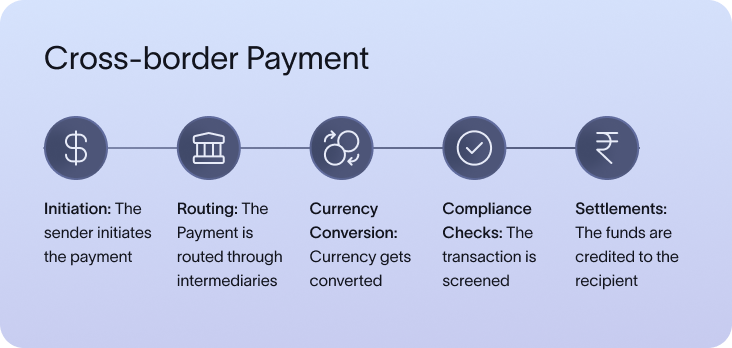
Behind every cross-border payment, there is a complex set of actions performed by various parties. The transaction starts from the initiator of the payment through the sending bank, moving through multiple intermediaries in between which finally routes to the receiving bank.
Here’s what happens in the background in a cross-border payment:
- Initiation: The sender makes a payment through their bank or payment provider. This step typically involves providing the necessary details, such as the recipient’s information and the amount to be sent.
- Routing: The payment moves through correspondent banks if using SWIFT or directly through payment platforms. Sometimes payments also movie through multiple intermediaries instead of just one.
- Currency Conversion: The sending currency is converted into the receiving currency, often at a markup. This process can result in additional costs, depending on the exchange rate applied and any hidden fees.
- Compliance Checks: Transactions undergo regulatory screening across jurisdictions, ensuring adherence to various legal requirements. This step helps mitigate risks related to money laundering, fraud, and terrorism financing.
- Settlement: The transaction is completed as the funds are credited to the recipient's account. The settlement process ensures that the recipient has access to the transferred amount, though delays may still occur depending on the system involved.
Banks and intermediaries have a key role in transaction costs and processing delays. Traditional cross-border payments usually involve the sending bank, 1-3 correspondent banks, and the receiving bank. Each institution performs its own checks and charges fees, adding to costs, delays, and inefficiencies that newer payment models aim to resolve by reducing or eliminating intermediaries.
Let’s paint a scenario where Maya, a writer based in Mumbai has completed a project for a company named Spark Ltd based in New York for $ 500.
Spark Ltd initiated a transaction via its bank, Bank Z, and sent the amount in $ to Bank A (Maya’s Bank).
Let us assume Bank Z does not have a direct relation with Bank A (Maya’s Bank) and is routed via 2 banks.
Bank D (correspondent to Bank Z) and Bank F (correspondent to Bank A)
Each intermediary processes the payment and charges a small handling fee.
Each bank will run compliance checks.
After a few days, the funds arrive in Maya’s account in INR (Bank A). The amount will be lower than actually transferred due to the handling and conversion fee charged.
Why do cross-border payments matter?
Now that we have a brief understanding of the process that cross border payments entail, let’s discuss why they really matter.
Today, even small businesses now routinely engage with international suppliers, partners, and customers. The COVID-19 pandemic has boosted this shift, with several firms looking to make their business global. For businesses of all sizes, the ability to send and receive international payments efficiently can be the difference between success and failure.
Impact on different types of businesses
When it comes to international payments, every business has its own set of unique challenges. From procurement delays and supply-chain bottlenecks to stretched credit cycles, the challenges compound more when you have an unreliable payment process.
- Low fee payouts: For instance, startups looking to raise funds globally need reliable, cost-effective ways to transfer capital across borders. IT service exporters on the other hand require efficient systems to receive payments from international clients without excessive fees eating into their margins.
- Local Payments and Reach: E-commerce businesses also need to offer localized payment methods to customers worldwide while managing cross-currency settlements. Whereas SMBs expanding internationally need affordable solutions that don't require sophisticated treasury operations.
- The Cost of Inefficiencies: Inefficient cross-border payment processes can hugely impact a business's bottom line and operations.
Hidden fees and unfavorable exchange rates can reduce payments by 3-5%, directly eroding profit margins. Payment delays disrupt cash flow and limit working capital availability, hindering business growth and daily operations. To top it, reconciliation issues create accounting headaches, consuming valuable time and resources and often requiring dedicated staff to resolve discrepancies. The cherry on the cake is compliance issues which can lead to rejected payments or regulatory penalties, adding further complications and costs.
As one IT service exporter noted: "Cross-border payments for businesses in India often come with endless fees and frustrations. Xflow has been a game-changer--streamlined, transparent and hassle-free."
What are the challenges with cross-border transactions?
Now that we’ve established how important cross-border payments are, it’s only fair to look at the challenges that come with them. Cross-border payments come with way more headaches than domestic ones. These can be anything from logistical issues (not receiving raw materials on time) to financial and trust issues (the seller requiring a letter of credit before commencing the deal) to economic issues (recession and war). All of these lead to delayed or stuck payments, long credit cycles, and regulatory and compliance roadblocks.
- Hidden Costs : High fees and FX markups are also quite a substantial burden. Traditional cross-border payments involve multiple fees, including SWIFT charges and currency conversion costs with hidden markups of 1% to 3%. Businesses also face additional taxes like GST on conversion costs, further eroding the value of money.
- Slow Transfers & Poor Visibility : Aside from the financial burden, delays and limited tracking capabilities create uncertainty and cash flow challenges. When money passes through multiple intermediary banks, it causes significant delays. SWIFT transactions typically take 2-5 days to reach the recipient's account. Companies struggle with limited visibility into where funds are during the transfer journey and face difficulty predicting exactly when the receipt will happen, complicating financial planning.
- Complex Compliance Requirements: Regulatory and compliance issues add additional layers of complexity to international transfers. Each country in the payment chain has its regulatory framework, including Anti-Money Laundering (AML) rules, Counter-terrorism financing (CTF) standards, Know Your Customer (KYC) requirements, and local reporting and documentation requirements. Navigating these complex regulations requires specialized knowledge and resources.
- Fragmented Global Infrastructure: A fragmented global payments infrastructure is infamously known to create technical obstacles. Different countries use different payment systems with limited compatibility between them and varying technological capabilities across regions. This diversification makes it difficult to create standardized, efficient processes for global transactions.
- Lack of Transparency in Transactions: Finally, the lack of transparency is another ongoing challenge for financial management. Many businesses struggle with unpredictable total costs, uncertain exchange rates, difficulty reconciling expected versus received amounts, and limited information for accounting and reporting purposes. All of this can complicate financial planning and lead to costly reconciliation efforts.
What are the different modes of cross-border payment?
Understanding the various payment methods is key to choosing the right solution for your business needs. Each method has distinct advantages and limitations, impacting transaction costs, processing times, and operational efficiency significantly.
- Bank Wire Transfers and SWIFT have long been the foundation of international banking. The Society for Worldwide Interbank Financial Telecommunication (SWIFT) network, an important channel partner, has been in existence for 40 years. While it is reliable for high-value transactions, it involves higher fees due to correspondent banking relationships, longer processing times (2–5 days), and limited transparency into charges and processing status. These are increasingly facing stiff competition from digital alternatives.
- Digital Wallets and Payment Platforms are modern alternatives with compelling advantages. Solutions like PayPal, Wise, and Xflow provide faster processing times, lower and more transparent fees, simpler user interfaces, and integration with business software. Smoother cross-border payments have been made possible by digital payment platforms, reducing friction and costs with accessibility to businesses of all sizes.
- Virtual Bank Account Numbers (VBANs) and Local Payouts are innovative solutions streamlining international receivables. Businesses can receive payments as if they had a local bank account in another country, convert payments to their home currency at favorable rates, and eliminate the need for multiple international bank accounts. These have helped reduce the complexity and cost of managing global payment collections significantly.
- Cards offer different options suited to specific transaction types. Some of these include credit/debit cards for C2B payments (though expensive for B2B), account-based transfers for efficient high-value B2B transactions, and eWallets, which are convenient for smaller payments and individual remittances. Selecting the appropriate payment rail can have a major impact on transaction economics.
- Letters of Credit and Documentary Collection serve specialized needs in international trade. Payment methods include Letters of Credit, which are bank guarantees of payment upon fulfillment of specified conditions, and Documentary Collection, where the seller's bank collects payment from the buyer's bank. These methods provide security for high-value commercial transactions but need expertise for effective implementation.
Innovations & trends in cross-border payments
As the industry continues to grow, it is also constantly evolving and coming up with newer and more innovative solutions to solve the payments problem. Here are some of the current trends for us to explore:
Rise of real-time payment networks
Instant payment systems are growing at a large scale, with research expecting it to grow from 16% in 2023 to 22% of transaction volume by 2028. Funds are being made available instantly with 24/7 processing, enhanced transaction data, and improved reconciliation of accounts.
Such expansion of real-time infrastructure is also allowing businesses to have better cash flows and treasury operations. They are increasingly competing with their decades-old batch-processing systems at a rapid pace.
Localization of cross-border payments
Innovative providers are transforming international transactions by using domestic payment rails in place of SWIFT. This is made possible through virtual account numbers in different countries. Businesses can collect payments via local methods, reducing costs and speeding settlement times.
This is truly redefining the way cross-border payments usually work by treating them as connected domestic transfers rather than disjointed international wires. Localization offers specific advantages for businesses with regular payment flows in select corridors or those wanting to provide customers with familiar payment experiences.
Enhanced transparency and predictability
Modern solutions are making cross-border payments transparent with guaranteed exchange rates, upfront fee disclosure, real-time tracking, and predictable settlement times.
Businesses can manage international payments with the same confidence and predictability as domestic transactions. Prompt visibility throughout the payment journey also improves customer experience and reduces support inquiries around payment status. The good news is that the industry is increasingly moving toward standards requiring providers to disclose the total cost of payments, including exchange rate margins.
Digital public infrastructure and regulatory changes
Governments and central banks are stepping up their game by creating initiatives and regulations to make cross-border payments smoother. Popular examples include ISO 20022 standardization for richer payment data, Central Bank Digital Currencies (CBDCs) exploration, regulatory frameworks for fintech innovation, and cross-border payment system interoperability initiatives.
Going hand-in-hand with private sector innovation, these initiatives will fundamentally change the way we view cross-border payments. A recent example includes the G20's roadmap for enhancing cross-border payments to address structural challenges in international transfers through policy and technological solutions.
Key features to look for in a payment partner
Choosing the right payment partner is like getting the right wi – fi – it should be reliable and fast. It is crucial for optimizing global transactions and driving operational efficiency. Lookout for these features when choosing a cross-border payment partner:
Speed of settlement
Fast access to funds is crucial to reduce working capital requirements. Rapid settlement capabilities can transform a company's liquidity position, allowing for more efficiency in the use of funds and improved financial planning. Businesses receiving international payments frequently can particularly benefit from partners prioritizing settlement speed. Prefer solutions offering next-day or same-day settlement to enhance your financial operations.
Low-cost FX and fee transparency
Imagine earning in high value currencies and not being able to make the most of it due to fees you didn’t even know about. Hidden fees can heavily reduce the value of international payments. Choose providers that offer transparent pricing structures, disclose FX rates upfront, avoid hidden markups, and provide clear transaction fee information. Fee transparency allows businesses to accurately forecast the true cost of international operations and avoid budget surprises. Many traditional providers embed high margins in exchange rates without clear disclosure, so partners committing to transparency can offer a massive advantage.
Compliance and regulatory support
As we have seen, international payments involve complex regulatory requirements. Ideal partners should automate compliance documentation, handle reporting requirements, provide necessary paperwork like eFIRA (Foreign Inward Remittance Advice), and stay up-to-date with changing regulations. Effective compliance support reduces administrative burden and mitigates the risk of payment delays or rejections. Regulatory requirements for cross-border payments continue to evolve, making partner expertise in this area highly valuable for businesses without dedicated compliance teams.
Multi-currency and local payout support
Versatile payment solutions should support all major currencies, offer local payment methods in target markets, provide multi-currency account capabilities, and enable efficient currency management. This flexibility can make business seamless across different markets while minimizing currency conversion costs and optimizing transaction efficiency. The ability to hold balances in multiple currencies also provides strategic advantages for managing exchange rate fluctuations and timing conversions advantageously.
Developer-friendly APIs
For businesses requiring integration with existing systems, look for well-documented APIs, easy integration with accounting software, automation capabilities for recurring payments, and webhook support for real-time notifications. Strong API capabilities make workflow integration seamless, and automation reduces manual processes and potential errors. Technical documentation quality and implementation support vary a lot among providers, making this a key consideration for businesses with complex integration requirements.
How to choose the right cross-border payment provider
Selecting the optimal payment solution needs a thoughtful assessment of your business needs. Consider these factors when evaluating providers:
Business size and payment volume
Different payment solutions are tailored to different business scales. For small businesses with lower payment volumes, cost-effective, straightforward solutions may be sufficient. Larger enterprises may need systems supporting higher transaction limits, bulk payments, and automated reconciliation.
Markets served
It is important to ensure the payment solution covers all regions where your business operates or plans to expand. Some providers excel in specific corridors or regions, offering better rates or faster settlement times for particular markets. Verify that the provider supports all countries you send to and receive from.
Payment frequency and value
The frequency and size of your payments will determine the ideal solution. High-frequency, lower-value payments require efficient microtransaction handling, while occasional large transfers may prioritize favorable exchange rates and terms for high-value payments.
Integration requirements
A payment solution must be compatible with your existing systems, whether that's your ERP software, accounting system, or e-commerce platform. This ensures seamless data flow and reduces manual entry errors. Evaluate the quality of documentation and implementation support available.
Currency needs
Assess the range of currencies you need to send or receive. If you deal in multiple currencies, selecting a provider that offers competitive exchange rates across all your required currencies is essential. Consider whether you need to hold balances in multiple currencies or convert immediately.
Regulatory requirements
Choose a knowledgeable provider of the regulatory landscape in all your operating jurisdictions, ensuring your payments comply with local laws and reporting requirements.
All in all, when evaluating potential partners, consider asking these set of questions-
What are the all-in fees, including FX conversion costs?
How quickly will funds be available to the recipient?
Do senders and recipients have visibility of the transaction status?
How do you handle compliance documentation?
What currencies and countries do you support?
Can you guarantee the final amount the recipient will receive?
Red flags to watch out for
- Be cautious of providers that-
- Don't disclose their FX markup
- Have opaque fee structures
- Offer limited support options
- Can't provide clear compliance information
- Have significant negative reviews about settlement delays
Modernize your cross-border payments with Xflow
Efficient cross-border payment solutions can make all the difference to your global business operations. The right payment system can turn a common challenge into an advantage and make businesses more confident in expanding to new markets, building stronger relationships with international partners, and optimizing cash flow and working capital. It can also help reduce administrative burdens and enhance financial visibility and control.
Modern cross border payment platforms like Xflow are addressing the traditional challenges of international payments head on by eliminating SWIFT fees, offering transparent foreign exchange rates, providing next-day settlement, and automating compliance processes. Innovations like these are allowing businesses to focus more on growth than deal with the complexities of payment logistics. As you evaluate your cross-border payment needs, make it a point to prioritize providers that offer transparency, efficiency, and features most relevant to your business model. The right partner will not only help scale your business but also support your international growth journey with minimal friction!
Frequently Asked Questions
SWIFT (Society for Worldwide Interbank Financial Telecommunication) is a messaging network that banks use to transmit information and instructions securely. While SWIFT itself doesn't transfer funds, it enables banks to exchange payment instructions. Alternative methods like payment platforms often use different networks, local banking relationships, or innovative technologies to move money more efficiently, typically resulting in faster transfers and lower costs.
To reduce the costs of international payments, consider using specialized payment platforms compared to traditional banks, as they often offer lower fees and better exchange rates. Consolidating payments can help minimize per-transaction costs, allowing you to make fewer, larger transfers rather than multiple small ones. It's also important to choose payment providers that offer transparent foreign exchange (FX) rates so you're not hit with hidden costs. For businesses with higher transaction volumes, negotiating better rates with payment providers can lead to significant savings. Additionally, exploring local payment methods where available can help avoid expensive international transfer fees and streamline the process.
When working with payment providers, it's beneficial to choose those that offer automated compliance documentation, which can save time and reduce errors. Providers that assist with regulatory requirements ensure that your business stays in line with international laws and regulations. They should also have up-to-date knowledge of changing international regulations, helping you navigate complex legal landscapes. Additionally, a good provider will generate the necessary paperwork, such as the eFIRA for Indian businesses, simplifying the compliance process and making international payments smoother.
Yes, some service providers like Xflow offer guaranteed exchange rates in partnership with global banks for specific time windows, allowing businesses to know exactly how much will be received in the local currency. This eliminates uncertainty and aids in financial planning.
Think about the countries you frequently send to or receive from since some providers offer better rates or services in certain regions. Also, check if the provider can integrate smoothly with your existing systems to avoid complications. Be clear about your fee tolerance, as costs can vary between providers, and ensure they can meet your settlement time requirements for timely transactions. Finally, evaluate your customer service needs, as good support is crucial for resolving any issues quickly. Once you’ve identified these factors, compare providers to find the best one that meets your business's requirements.
For most Indian exporters, ITeS firms and freelancers, a collection platform such as Xflow fits best, because it settles foreign currency to an Indian bank in INR with a FIRA and purpose codes applied. Skydo is a flat-fee alternative; Wise or Payoneer work too, but leave more compliance to you.
Yes. A collection platform like Xflow gives you foreign-currency receiving accounts, collects in 25+ currencies, and settles the money to your Indian bank account in INR on the next business day, with an EEFC option if you prefer to hold foreign currency.
Choose Xflow if you are an Indian business that needs foreign currency settled to an Indian bank with FIRA and RBI compliance handled. Wise suits a global multi-currency wallet, and Payoneer suits sellers paid through marketplaces like Upwork or Fiverr.
A multi-currency account holds balances across currencies for you to convert later. A collection platform receives a customer's payment and settles it to your home bank in your currency with the local paperwork, which for India means the FIRA and purpose code.
Yes. On Xflow a free FIRA is issued by an RBI-authorised bank for every withdrawal, and the FIRC is still available from the bank. Your downstream EDPMS, SOFTEX and GST-refund workflow does not change when you move off a direct SWIFT wire.
Xflow supports receiving in 25+ currencies from 140+ countries, with a USD receiving account free on sign-up. Funds are then settled to your Indian bank account in INR at the mid-market rate.